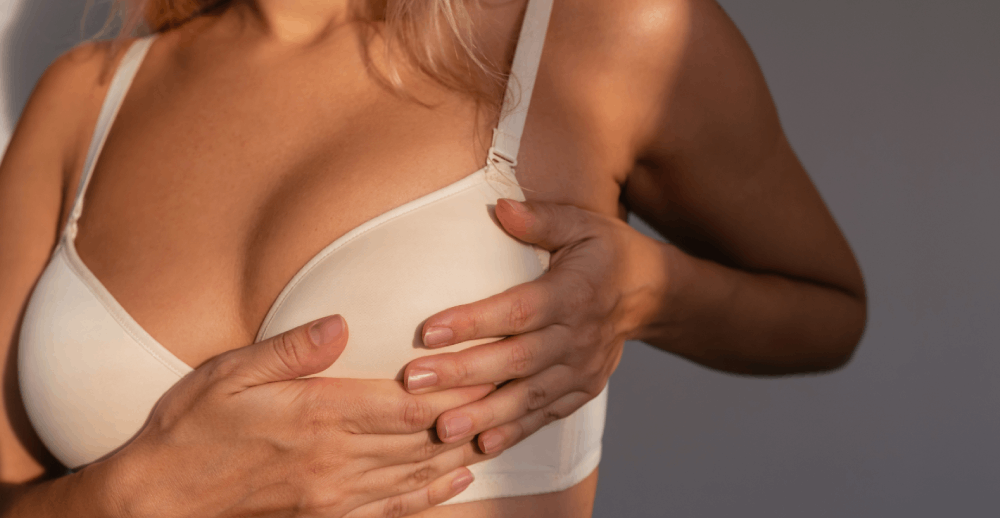
 Breast implants can offer beautiful and natural-looking results for several years (or even decades), but they’re not designed to last a lifetime. You may notice changes in the look and/or feel of your breasts over time, or your preferences may shift and you may not necessarily desire your implants as you age. While many patients experience no issues with their implants, those who notice potentially problematic symptoms or who no longer feel emotionally aligned with their augmentation have options to address their concerns.
At our NYC-area practice, Westchester plastic surgeon Neal Goldberg, MD, FACS has decades of experience skillfully performing breast implant removal, breast revision surgery, and breast reconstruction revision for women who want to refine their primary augmentation or who want to return to their natural contours. He personally designs a treatment plan tailored to your needs to provide you with the results you envision and help you reclaim a more authentic version of yourself. Below, he outlines common signs to be aware of that may warrant removal or revision of your implants.
Your Breasts Feel Firm or Hard to the Touch
Capsular contracture, or hardened scar tissue, is among the most common reasons for breast implant removal or revision. Every implant naturally develops a layer of scar tissue around it as the body’s natural response to a foreign object. This is a normal part of healing and presents no cause for concern unless the scar “capsule” tightens and hardens excessively.
If your implants feel “off” or you suspect a change in your breasts, it’s important to keep an eye out for potential signs of capsular contracture, such as:
- Firmness or hardness in the breasts that wasn’t there before
- Visible distortion in the shape of the breast (it may look rounder, higher, or asymmetrical)
- Discomfort, tightness, or pain, especially when lying down or during physical activity
- A breast that feels noticeably different in texture from the other side
Visible “Deflation”
If you have saline implants, an implant that has lost volume or looks “deflated” often signifies a tear or rupture in the device. In cases of saline implant rupture, the saline solution is absorbed harmlessly by the body, causing the affected breast to visibly deflate over the next few hours to days.
Silicone implant rupture is harder to detect because these devices are made from cohesive gel and often keep their shape in the event of a leak or tear. Since silicone implants rupture “silently,” patients should be vigilant to signs of a potential issue, which may include:
- Changes in size, shape, or symmetry
- New lumps or firmness
- Tenderness, swelling, or tingling
- Changes in sensation in the breast or nipple
Other Changes in Appearance (Implant Rotation, Bottoming Out, Etc.)
Whether due to gravity, shifts in weight, natural aging, pregnancy, or other factors, visible distortion in how your breasts look can be indicative of capsular contracture, rupture, implant rotation, migration of the implant to the center of the chest, or “bottoming out.” These issues can be corrected with a personalized breast revision procedure and don’t necessarily warrant full implant removal for those who wish to keep their implants; however, explantation can be an option for women who want to remove their implants for their own peace of mind or who would rather rejuvenate their breast profile with mastopexy (breast lift surgery) to lift and reshape their breasts.
Ongoing Pain and/or Discomfort
Persistent pain or discomfort around your implants should always be evaluated by a medical professional, as these symptoms can be associated with Breast Implant Illness (BII) — a wide range of systemic reactions that some patients report starting after receiving breast implants, such as:
- Ongoing fatigue
- Joint and muscle pain
- Cognitive difficulties and brain fog
- Hair loss
- Recurring fevers
- Rashes and skin inflammation or sensitivity
While there is no official medical diagnosis for BII, symptoms frequently improve (or disappear altogether) after breast implant removal. If you’ve been experiencing any combination of the above symptoms after undergoing breast augmentation, it’s essential to safeguard your health by consulting with your primary care physician or a board-certified plastic surgeon.
Swelling or Fluid Buildup Around the Implant
While implants are considered safe devices with decades of clinical support outlining their effectiveness, there are medical conditions that may be associated with use of certain implant types. Breast Implant-Associated Anaplastic Large Cell Lymphoma (BIA-ALCL) is a rare cancer of the immune system, most strongly associated with textured-surface implants. This condition is not a breast cancer, but a cancer of the tissue surrounding the implant. Symptoms generally include:
- Persistent swelling around the implant, often occurring well after the surgical site has healed (sometimes years later)
- Fluid buildup (seroma) around the implant
- A lump in the breast or armpit
- Pain or asymmetry that develops suddenly (often long after the initial surgery)
BIA-ALCL is rare but should be taken seriously. Any late-onset swelling or fluid accumulation should be evaluated promptly by your doctor.
No Longer Feeling Authentic to You
While many reasons for breast implant removal are medical, the feeling of not feeling like yourself with your implants in place is enough reason to consider explantation. It’s natural for preferences to change over time and some patients want a more natural look as they age. Others no longer want to maintain their implants over the long-term (including the possibility of future replacement surgeries). Lifestyle changes, such as increased athletic activity, may also make breast implants feel more physically limiting, prompting the desire for removal.
If you’ve experienced a shift in what feels aesthetically or emotionally right for your body, Dr. Goldberg can speak with you about breast implant removal to determine the best course of action. Once your implants have been removed, he can also restore your natural breast shape while renewing your breast contours with breast lift surgery and other advanced techniques.
Reviewed By: Westchester Plastic Surgeon Neal Goldberg, MD, FACS
Speak with a Board-Certified Aesthetic Plastic Surgeon
If you have concerns, don’t wait until your symptoms worsen. Please reach out to the office of Dr. Neal Goldberg today to discuss your goals with a compassionate and knowledgeable plastic surgeon.